 Sylvie Parent : What is your background as an artist and what brought you to the Web?
Zoe Leoudaki : I started out as a painter. I made big, chaotic canvases with a lot of texture. Early on, I was trying to capture the ultimate White, (1984 to 1988). Later on, I realized that to capture this ultimate White I had to learn how to paint the ultimate Black (1988-1995) Even though, I enjoyed and still enjoy the physicality of painting, I felt there was something missing. I needed a connection to the people around me that was less esoteric and self referential than the work I had been doing. I started doing reliefs with plaster, casting stone and clay. By appropriating objects, some of a ceremonial nature, and by making multiple casts I created pieces that looked like fragmented freezes of the ancient Greek temples. I felt that, since, they included an object, that pre-existed and was not made by me, I could be more connected with the outer world. But still, I felt an immense gap between myself and my art and people around me. I felt that what I was doing could not travel beyond the consciousness of a few artists and a even fewer friends.
At the same time that I was going through my internal artistic turmoil,
e-mail had made a timid appearance and list-servs came into being. I
became a member of one that discussed art related issues, I think it was
called Artcrit. One day I received a message from a male fellow artist
who was experiencing a creative block and was reaching out for help. I
sent him a personal message trying to console him. From that point on I
became his confidant. He talked to me about his life and I listened. I
was shocked about how open one can be to a complete stranger. He talked about
his failing relationship with his wife, their sexual problems, his ex
lover and his kids. He never asked me about myself, but proceeded to
"fall in love" with me. He even staged an e-mail seduction scene. After a
year, I thought it would be a good idea to exchange pictures. So, I sent
him a b&w close up of myself. I never heard from him again. I broke the
code of anonymity and finally had a face. All this happened in 1992, and
in the years to come I forgot about it, until the fear project came
along.
When the idea for the Fear installation came into being I was trying to figure out what would be the best way to make people talk about intimate things and be truthful. At that point I was thinking more about my immediate environment and not about peoples at the other side of the world. I thought of doing phone interviews, getting a toll free number (1-800- fear?..), or even creating a confessional phone booth. But I thought they were all intimidating solutions with various cultural and practical limitations.
My husband, Lawrence Swiader, is website designer. One day I asked him a very simple question. Can we create a website where I ask people what they are afraid of? He said yes. And can they type their response and send it back to us? He said yes again. And that was it. I wrote the text, I wanted it to be very simple and straightforward, as if reading a young girl’s diary. We agreed on the various sections of the site and the links. We started working on it together and got into terrible fights. So I let him work on it. Larry put the whole thing together in a day or two. He came up with the design which I find very intimate and expressive of what I was trying to achieve. At the time, I was doing monoprints on torn pieces of paper. He tore and scanned pieces of paper to give the site that look it has. It was a truly collaborative project.
The web proved to be the perfect solution for this project because it transcends time and space. It’s intimate and one can keep their anonymity, which is crucial for this project. I also wanted people to think before they answered. When you have to write something, you tend to think about it before hand, whereas, when you talk or answer a question you can be a little more superficial. Judging from myself, it’s easier to be more truthful when I write and I’m alone, than when I’m facing another person and are expected to answer verbally. And I think, the responses I got proved my initial premises to be true. A lot of the people who answered, you can tell, thought about it pretty seriously.
I still read their responses and I’m very moved. And their answers reveal to me that there is a human and spiritual bond that links us all, and goes beyond, sex and ethnicity.
My most recent work are installations using sound, painting and sculptural elements. I’ve been interested in making pieces that include what I call reality bites, confessions by real people dealing with fears, phobias and nightmares and, also, found sounds. This process produces work that’s less self referential and more open to variety of interpretations and different levels of understanding.
So, I take small fragment from different kinds of realities - images, sounds, voices, fairy tales - and turn them into installations that tell stories about the hidden aspects of the human psyche. Lately, most of the pieces I do seem to focus on childhood memories and women’s issues. This did not start out of a cognizant choice, it just came out of the work.
My installation The shadow of her smile (1999) was a sound piece dealing with sexual violence. White fabric partitions delineated three sides of a square room. In the middle stood a draped square table with a round marble vessel filled with water. The voice of a woman who had experienced rape was heard reciting her story.
Little Red’s esCape (1999) deals with the interplay of the self and society. It’s a mural of the Little Red Riding Hood in three different stages as depicted on the three walls of a white room. On the left wall as you enter she appears naked, then wearing her red cape and finally, the cape appears floating on its own. Under the cape is writing that reads: Don’t go through the woods, take the well-cleared path to your grandmother’s house and remember don’t talk to strangers, just be a good girl, and don’t forget we all love you very much and we worry about you. Go now.
S.P. : Why did you choose the Fear as the theme for your Web work?
Z.L : I come from a fearful family and a fatalistic country. My family is afraid of everything and Greeks, as a whole, believe that nothing will ever change. Also, I’ve always been a full-time psychotherapist for my friends, in both countries (the States and Greece), and all of them would not do things because they were afraid. I fall in this category too.
Also, I wanted to ask people a question that is not often asked of them, because it’s too personal. It’s a question that transcends the boundaries of the self and probes into uncharted territories that not all want to travel. Some people have thanked me for asking that question and for providing a forum for their answers to be heard, and in some ways enter a public domain. I’ve had friends that came over to my place and spent two, sometimes three hours straight in front of my computer to read all the confessions. From time to time they would go: Oh, I’m afraid of that too.
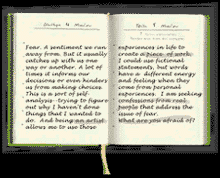
The website now has a life of its own. It’s been up since May 1998 and we still get an average 10 confessions per week, sometimes more. The counties of origin are not only the US and Canada, or Greece, but Argentina, Australia, Belgium, Brazil, Chile, China, Colombia, Costa Rica, Estonia, Cyprus, France, Hong Kong, Iceland, India, Israel, Korea, Mexico, the Netherlands, Norway, New Zealand, Philippines, Portugal, Russia, Saudi Arabia, Singapore, South Africa, Spain, Tanzania, Turkey, the United Arab Emirates, Venezuela and Yugoslavia.
S.P. : Can you explain the different parts of your Web project and how they are related to one another?
Z.L. : This web project is part of an installation piece called The Descent of Chimera. Based on the confessions that I get, I’ll create a sound piece, using male and female voices, together with a video component at the altar of the neo-gothic church that houses the Angel Orensanz Foundation for the Arts in New York City, probably in May 2000.
S.P. : In which ways do you believe the Internet can be used as a mode of expression and/or action for artists?
Z.L. : I think the Internet is still in its nascent stages. The more technology advances and becomes mainstream the more possibilities will be to make art. What I find enticing in the Web is it's nonlinear quality of organizing information that is very close to the way we dream, or make connections with various disparate aspects of reality. Ultimately, technology is just another tool to make art, what comes first is intent, that can materialized in the form of a piece, whether it’s virtual or actual and in its turn create a shift in the consciousness of the people who experience it.
S.P.: Internet is a space filled with information of all kinds, a lot of which
is totally unnecessary, a lot of which, also, is offensive. In addition,
E-commerce is now all over the Web and make it similar to a huge
shopping center. For these reasons, cyberspace is often compared to a
jungle, dense, brutal, unexpected. Hence, many artists react to these
aspects and their works can show opposition and agressivity towards
this. Conversely, other artists have chosen to use this medium by
focusing on its positive side, as a means of communications, as a way to
reach people and make contact, as a way to "humanize" this space. How do see
the Fear project in respect to these considerations?
Z.L.: The Fear website uses the capabilities of the Internet and e-mail to create
a link of consciousness between people. What we are afraid of tell us who we
are. After reading the confessions from people in different countries I
realize that these fears emphasize the common thread of human experience
that, in most cases, seems to be beyond culture and nurture. A lot of people
have asked me to answer their messages and I have. Some have even asked me
for advice. I really feel indebted to all who have taken the time to
respond, and some have talked about very personal and painful issues.
Sometimes, when I'm frustrated with the art world, I go back and read some
of the messages and feel that I've tapped into a something very real and
basic, and fear is a very basic instinct. I only hope that the final
installation will manage to retain this humanness.
The Internet has given me the capability to go reach out my circle of
friends and travel beyond geographical borders and into the psyche of people
who are very different than me. I'm grateful that I was able to take this
trip. It sensitized me to things, or rather fears, that I couldn't relate to
in the past. So I feel that the final installation will be informed not only
from my personal experience but, also, from those of the people that I have
somehow reached.
S.P.: I would also like to hear you more about the transitional aspect of your
work on the Web, the fact that it was created from the real world into the
virtual and that it is the basis for another project in the real. Do you
believe the Web project is just a part of the whole or a work in itself?
Z.L.: Life is transitional and so is any piece of art, including the Parthenon. I
could keep the website going on for a very long time. It would be like
having an endless work in progress, where the "progress" is the work. I'm
still very excited when I check my e-mail to find new responses, they are
the first I open.
This website is part of the whole and a work in itself. Larry's design has
made it such together with the content.
S.P.: In the field of new media art, the conception of the artist as the
initiator, someone who starts the project but lets the content be
generated by others, is becoming very important. What do you think about
this conception? Is it more specific to Web art of new media art? Do you
think it is also common to other arts?
Z.L.: If you think about it, content, when talking about art, is always generated
through the artists mental, psychological, political, physical interaction
with the "other" or the "world". Whether the outcome of this interaction is
used raw, in its primal form, or processed doesn't really matter to me, the
final outcome matters. Is this piece able to create a shift in consciousness
that engages the viewer or not? That's where the whole issue lies.
Zoe Leoudaki a été invitée par Sylvie Parent, en tant qu'artiste de la Méditerranée travaillant sur le Web, dans l'exposition Che c'è di nuovo présentée à la Casina Pompeiana de Naples du 18 décembre 1999 au ...