


Paul-Émile Borduas’
Stay in the United States
(1953-1955)
By René St-Pierre, Ph.D.
Paul-Émile Borduas is recognized, both as an artist and as a thinker, for his contribution to the emergence and formation of modern Quebec. This synthesis examines a singular moment in his life: his stay in the United States between 1953 and 1955. It highlights the principal issues raised by this period, notably the evolution of his practice, his critical reception, the dynamics of the art market, and the breakup of the Automatist movement, marked by internal dissensions and divergent individual trajectories.
This brief chronological incursion addresses a pivotal phase in his career, from the publication of the manifesto Refus global in 1948 to his departure for Paris in 1955. It traces his time in Provincetown, from spring to fall 1953, and then in New York, through the winter of 1955, highlighting a simultaneous process of isolation and rebirth, both personally and professionally.
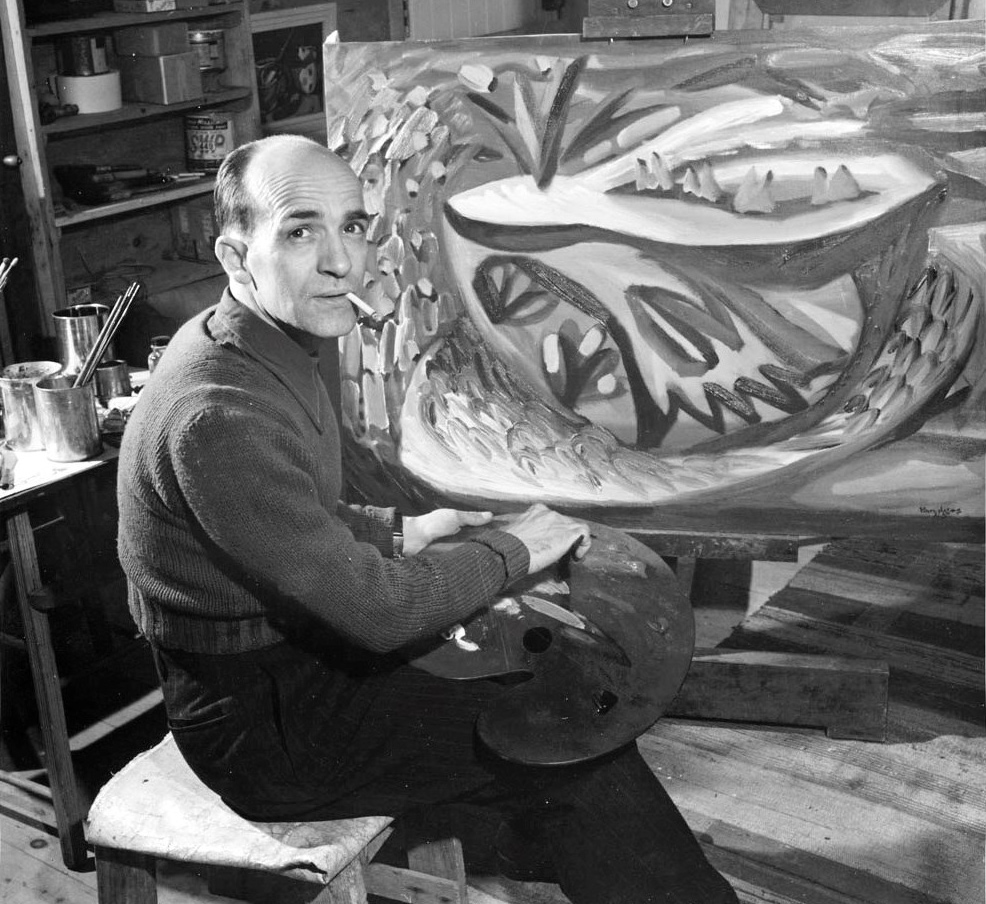
Paul-Emile Borduas – Bibliothèque et Archives Canada MIKAN 1946
Refus global: professional exclusion (1948‑1949)
On August 9, 1948, the manifesto Refus global, printed in 400 copies, was launched at the Librairie Tranquille in Montreal [1]. Written by Borduas and co-signed by fifteen young creators (seven women and eight men, a model of parity for the time), the manifest directly attacked conservative ideology and clerical hegemony (“To hell with the aspergillum and the tuque !”), and the values of Maurice Duplessis’s National Union government. The reprisals were immediate: on September 2, 1948, Gustave Poisson (Deputy Minister of Social Welfare and Youth) informed the director of the École du meuble, Jean-Marie Gauvreau, that Borduas was suspended without pay as of September 4, his writings being “not of a nature to promote the education of young people” [2]. At a press conference on September 21, 1948, Borduas protested, arguing that for eleven years his teaching had never departed from the curriculum [3]. Despite this, his dismissal would be made official. In response, during the winter of 1948-1949, he wrote his autobiographical essay Projections libérantes (published in July 1949), denouncing the director of the École du meuble while pleading for open education [4].
Tensions, poverty and solitude (1950‑1952)
Deprived of salary, Borduas withdrew to his house in Saint-Hilaire. He gave drawing lessons to children while selling watercolors at modest prices, refusing to let his wife, Gabrielle Goyette, return to work as a nurse. At the same time, the Automatist group was beginning to dismantle: the Riopelle couple (Jean Paul, Françoise L’Espérance) and the Leduc couple (Fernand, Thérèse Renaud) were now living in Paris (respectively since 1946 and 1947) [5], while in Montreal the younger generation (Claude Gauvreau, Jean-Paul Mousseau and Marcelle Ferron) wished to link art to social action. In March 1950, the 67th Spring Salon of the Montreal Museum of Fine Arts (MMFA) was held. Mousseau and Ferron organized the dissident exhibition of the “Rebelles” at 2035 Mansfield Street (from March 18 to 26, 1950). Although accepted at the Salon, Borduas chose to stand in solidarity with Les Rebelles by exhibiting five of his works [6].
To redefine the movement’s history, he wrote Communication intime à mes chers amis (April 1 to 9, 1950) [7], in which he sought to establish the distinction between poetic creation and political propaganda, which led Riopelle, then living in Paris, to accuse him of paternalism [8]. The artist’s distress culminated when, on October 19, 1951, returning from an exhibition in Toronto, he found his house empty: his spouse Gabrielle Goyette had left him without notice, taking their three children, Janine, Renée and Paul [9]. Devastated, admitting that he had handled a firearm and contemplated suicide [10], he sold his Saint-Hilaire house to Dr. Alphonse Campeau on April 24, 1952 [11].
Dreaming of a better life elsewhere, Borduas considered moving permanently to Europe, but he would first pass through the United States. The motivations surrounding the artist’s departure from Quebec were numerous and varied. In an exchange with his friend Sam Abramovitch in the summer of 1953, Borduas explained that his objective was to establish himself as a painter of international renown, that he could not achieve this by remaining in Montreal, and that the sooner he made the leap, the better his chances of success would be [12]. Although he had already considered going to Paris, Borduas did not wish to move too far away from his children following his recent divorce. A precipitate departure for France then seemed premature, all the more so because the Paris art market had not yet fully recovered from the effects of the Second World War [13].
New York City was highly attractive at the time. Françoise Sullivan had stayed there in 1945 and 1946 to take dance classes and create her first choreographies, and Louise Renaud had worked there as governess to the children of the art dealer Pierre Matisse during the 1940s. As early as 1944, she was the one who regularly informed her Montreal friends about cultural activities taking place there, relaying conversations she took part in at Matisse’s home in the presence of André Breton, Marcel Duchamp, Max Ernst and Arshile Gorky [14]. Françoise Sullivan and Jeanne Renaud confirmed to Claude Gosselin the determining role played by Louise Renaud in transmitting these activities to the Automatists who had remained in Montreal [15].
Determined to leave Quebec, Borduas saw his efforts to emigrate to the United States delayed by McCarthyism, because of an interview he had granted to Gilles Hénault in the communist newspaper Combat on February 1, 1947 [16]. He finally obtained a valid visa in March 1953 [17].
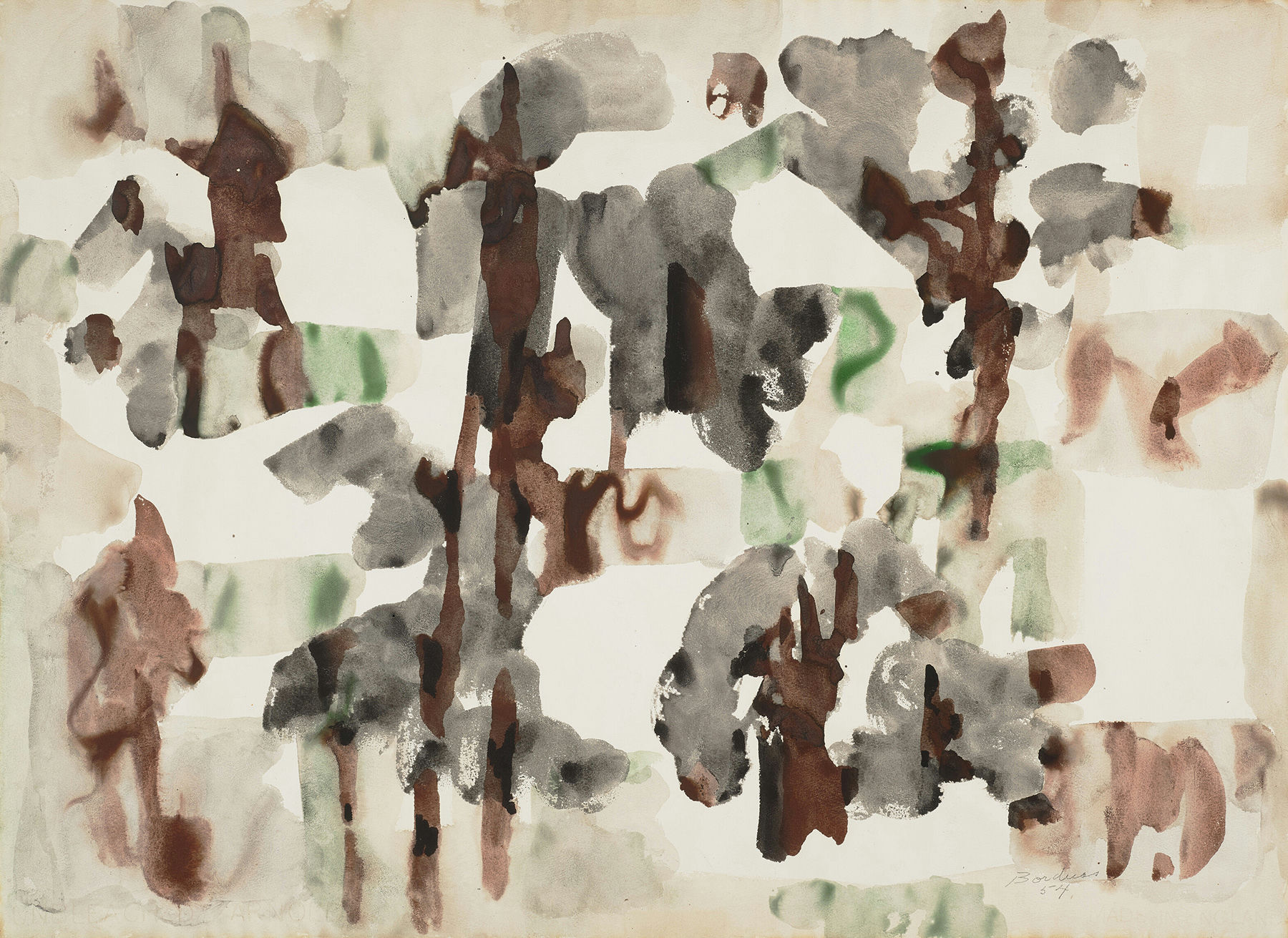
1954 – Blancs printaniers, watercolor on paper, 22 x 30 inches, Collection Galerie Cazeault, # CR : 2005-1051.
Provincetown, then New York (1953)
Borduas crossed the American border on April 1, 1953, at the Newport, Vermont, crossing, before heading to Boston and then Provincetown [18]. where, from May to September 1953, he rented a studio at 198 Bradford Street. This summer stay gave rise to a particularly creative phase, since he painted about forty canvases there [19]. Note: for an overview of this exceptional production made in Provincetown, see the Borduas catalogue raisonné for the year 1953. The artist left Provincetown for New York at the end of the summer of 1953 and settled on September 22 at 119 East 17th Street, in Greenwich Village [20].
Discovery of abstract expressionism (1954)
Borduas sporadically frequented the Cedar Street Tavern and the Eight Street Club, where he absorbed the vitality of the New York School. Frequented by artists, critics and intellectuals, these emblematic Greenwich Village venues served as informal meeting places, fostering exchanges and debates at the heart of the New York art scene. There Borduas discovered the works of major figures of Action Painting and abstract expressionism, notably Jackson Pollock, Franz Kline, Willem de Kooning and Adolph Gottlieb. Francophile American women artists such as Yvonne Thomas, and more particularly Florence Weinstein, facilitated his contacts. At the time, Florence Weinstein sat on the board of directors of the Museum of Modern Art in New York (MoMA). A personal friend of Borduas, Florence Weinstein likely encouraged him to offer the work Morning Candelabra to MoMA, a gesture that opened the doors of this prestigious museum to him [21].
In contact with this artistic current, fascinated by Kline’s black-and-white structures and Pollock’s expressive spontaneity, Borduas gradually abandoned the formal ground/object contrast to explore instead the spatiality of the surface (all-over) [22]. Setting aside brushes for the palette knife, he occasionally experimented with the technique of dripping in his watercolors and oils, notably in Graffiti of 1954 [23].
Exhibitions and the art market (1953‑1955)
In the United States, Borduas’s first solo exhibition was held from January 5 to 23, 1954, at the Passedoit Gallery (121 East 57th Street, New York), where he exhibited 24 canvases. Present at the opening, Rodolphe de Repentigny would report in the newspaper L’Autorité du peuple, under the pen name François Bourgogne, that Robert Motherwell, also present, had described Borduas as a “Courbet of the 20th century” [24]. Borduas subsequently exhibited in Philadelphia, at the Hendler (Hutzler) Gallery, from April 3 to 30, 1954. He presented about a dozen paintings there [25].
On October 19, 1954, Borduas attended the opening of the exhibition marking the 25th anniversary of the collections of MoMA in New York, an event during which his canvas Morning Candelabra, painted in Montreal in 1948, was exhibited [26]. The institution would also acquire the work La Guignolée, painted in New York in 1954 [27]. Another exhibition, titled Watercolors 1954, took place at the Passedoit Gallery from January 10 to February 5, 1955. Some sources place the closing of this event on February 6 [28] .
Before his departure for Europe, Borduas signed an agreement with the prestigious Martha Jackson Gallery [29]. The gallery would devote two important solo exhibitions to him: Paul-Émile Borduas. Paintings 1953-1956, from March 18 to April 6, 1957, which presented more than thirty works. Two years later, from March 24 to April 18, 1959, the gallery organized a second exhibition titled An Intimate Showing of Recent Paintings by Paul Borduas, which brought together about twenty works from the Paris period [30]. On the international scene, Borduas represented Canada at the São Paulo Biennial and at the Venice Biennale in 1954.
In Canada, collector-entrepreneurs supported him materially through purchases in lots. Thus Gérard Lortie bought five works from him in the spring of 1954 [31]. The solo exhibition titled En route, bringing together seventeen oils and six inks, was held at Galerie Agnès Lefort in Montreal from October 12 to 26, 1954, marking his return to the metropolis [32]. Finally, in a letter addressed to Gisèle Lortie and dated July 12, 1955, Borduas confirmed that Dr. Max Stern of the Dominion Gallery had just purchased a lot of eleven paintings from him [33]. In 1954 alone, he sold some fifty works, thereby securing an unexpected degree of financial security.
Critical reception and epistolary life (1954‑1955)
The specialized American press welcomed his arrival. In Arts Digest of April 1, 1954, Sam Feinstein detected the material vitality of his handling [34]. In Canada, an article in the Montreal Star published on October 16, 1954, by Robert Ayre, emphasized the beneficial impact of his American stay [35]. The Montreal critic Rodolphe de Repentigny, for his part, discussed the recent evolution of Borduas’ pictorial practice [36] . The fashion magazine Vogue published, in its April 15, 1955 issue, an article devoted to Canadian artists, Three Canadian Painters, presenting Borduas alongside Jean Paul Riopelle and B.C. Binning [37] . In June 1955, as he was planning his departure for Paris, Dorothy Gees Seckler of Arts Digest devoted an important text to him [38].
The New York period also saw an important increase in Borduas’ letter-writing activity. His correspondence testifies, among other things, to his affection for his children and to the intensity of a secret love relationship with Rachel Laforest [39]. The letters exchanged with Fernand Leduc and Claude Gauvreau also constitute genuine logbooks documenting the evolution of his thought [40]. On the theoretical level, he published an essay on the work of Ozias Leduc in Canadian Art in 1953 [41].
Quarrel with the Plasticiens and departure for Paris (1954‑1955)
In February 1955, while visiting Montreal for the exhibition Espace 55 at the MMFA, Borduas described the geometric painting in flat color planes of the younger generation as “archaic” [42]. Outraged by this attitude, Fernand Leduc responded in L’Autorité du peuple on March 5, 1955, accusing Borduas of condescension [43]. In reply, on March 12, Borduas published Objectivation ultime ou délirante, a manifesto written in New York on February 26, 1955 [44]. In it, he praised Pollock’s abstract expressionism, an act that definitely helped provoke the intellectual and aesthetic rupture of the Automatist group.
We know that Borduas had announced, as soon as he settled in New York, his intention to go to Europe within a two-year horizon [45]. His stay in the cultural capital acted as a decisive catalyst on the formal level, while also orienting the evolution of his practice. Several factors also helped weaken his ties to the United States: linguistic isolation, the individualism of the New York artistic milieu, and the personal project of rebuilding his life with Rachel Laforest led the artist to leave for Paris. On September 21, 1955, financially secured by his summer sales, Borduas left New York definitively for France aboard the ocean liner Liberté, accompanied by his daughter Janine [46]. The painter and his daughter disembarked at the port of Le Havre on September 26, 1955, before traveling on to Paris, beginning the final chapter that would lead him toward his celebrated black-and-white paintings.
Footnotes and references
[1] Paul-Émile Borduas, Écrits II, André-G. Bourassa and Gilles Lapointe (eds.), Montreal, Les Presses de l’Université de Montréal, coll. « Bibliothèque du Nouveau Monde », 1997, p. 284.
[2] Ibid., p. 274, note 186.
[3] Report of the press conference, Le Devoir (p. 2) and La Patrie (p. 6), September 22 1948.
[4] Paul-Émile Borduas, Projections libérantes, Saint-Hilaire, Éditions Mithra-Mythe, 1949.
[5] Anonymous, Paul-Emile Borduas 1905-1960. Montreal/Ottawa, Museum of fine arts of Montreal, National Gallery, 1962, p. 3.
[6] François-Marc Gagnon, Paul-Émile Borduas (1905-1960) : Biographie critique et analyse de l’œuvre, Montréal, Fides, 1978, p. 286.
[7] Paul-Émile Borduas, Écrits I, André-G. Bourassa, Jean Fisette and Gilles Lapointe (eds.), Montreal, Les Presses de l’Université de Montréal, coll. « Bibliothèque du Nouveau Monde », 1987, p. 503.
[8] Ibid.
[9] Ibid., p. 39.
[10] Claude Gauvreau, « L’épopée automatiste vue par un cyclope », La Barre du jour, January–August, 1969, p.48.
[11] François-Marc Gagnon, Paul-Émile Borduas (1905-1960), op. cit., p. 314.
[12] Sam Abramovitch, « Borduas d’hier à aujourd’hui », in La magie des signes, (Josée Bélisle ed.), Montreal and Versailles, Musée d’art contemporain de Montréal and Conseil général des Yvelines, 2004, p. 24.
[13] Email correspondence with Gilles Lapointe referring to Écrits de Borduas, Tome II, 1953-1955 period, April 1, 2026.
[14] François-Marc Gagnon, Chronique du mouvement automatiste québécois 1941-1954, op. cit., p. 100-101.
[15] François Lévesque, « Louise Renaud, signataire de «Refus global» et passeuse d’art, s’est éteinte », Le Devoir, October 23, 2020.
[16] Interview with Borduas by Gilles Hénault in Combat, February 1, 1947, p.1.
[17] Paul-Émile Borduas, Écrits I, op. cit., p. 40.
[18] Ibid.
[19] François-Marc Gagnon, Paul-Émile Borduas (1905-1960), op. cit., p. 322.
[20] Paul-Émile Borduas, Écrits I, op. cit., p. 40.
[21] Ibid., p. 621, note 165.
[22] François-Marc Gagnon, Paul-Émile Borduas : Sa vie et son œuvre, Toronto, Art Canada Institute, 2014. p.34.
[23] Ibid, p. 57.
[24] François Bourgogne, « Chez Borduas, à New York », L’Autorité du peuple, February 6, 1954, p.7.
[25] François-Marc Gagnon, Paul-Émile Borduas (1905-1960), op. cit., p. 491.
[26] Ibid., p. 371.
[27] Ibid., p. 396.
[28] Anonymous, Paul-Émile Borduas 1905-1960, op. cit., p. 35.
[29] Ibid.
[30] François-Marc Gagnon, Paul-Émile Borduas (1905-1960), op. cit., p. 502.
[31] François-Marc Gagnon, Paul-Émile Borduas (1905-1960), op. cit., p. 386.
[32] Ibid., p. 491.
[33] Ibid., p. 386.
[34] Sam Feinstein, « Philadelphia, Paul-Émile Borduas », Arts Digest, April 1, 1954. p.22.
[35] Robert Ayre, « Impact of New York Has Been Good for Paul-Émile Borduas », The Montreal Star, October 16, 1954.
[36] François-Marc Gagnon, Paul-Émile Borduas (1905-1960), op. cit., p. 336-337.
[37] Paul-Émile Borduas, Écrits II, op. cit., p. 770.
[38] Dorothy Gees Seckler, « Paul Emile Borduas », Arts Digest, vol. 29, n°17, June 1955, p. 8-10.
[39] Paul-Émile Borduas et Rachel Laforest, Aller jusqu’au bout des mots. Correspondance 1954-1959, Montreal, Leméac, 2017, p.6.
[40] Fernand Leduc, Vers les îles de lumière – Écrits (1942-1980), André Beaudet (edit.), Ville LaSalle, Hurtubise HMH, 1981.
[41] Paul-Émile Borduas, « Quelques pensées sur l’œuvre d’amour et de rêve de M. Ozias Leduc », Canadian Art, vol. 10, no 4, 1953, p. 158-161.
[42] Radio interview with Paul-Émile Borduas and Gilles Corbeil on Espace 55, February 1955.
[43] Fernand Leduc, « Leduc vs Borduas », L’Autorité du peuple, March 5, 1955, p.5.
[44] François-Marc Gagnon, Paul-Émile Borduas (1905-1960), op. cit., p. 374.
[45] Guy Gagnon, « New York accueille Borduas, le peintre de Saint-Hilaire », Le Clairon, January 8, 1954, p. 4.
[46] Paul-Émile Borduas, Écrits I, op. cit., p. 42.
Bibliography
- ABRAMOVITCH, Sam, « Borduas d’hier à aujourd’hui », in La magie des signes, (Josée Bélisle ed.), Montreal and Versailles, Musée d’art contemporain de Montréal and Conseil général des Yvelines, 2004, p.24.
- ANONYME, Paul-Émile Borduas 1905–1960, Montreal/Ottawa, Museum of fine arts of Montreal, National Gallery, 1962.
- AYRE, Robert, « Impact of New York Has Been Good for Paul-Émile Borduas », The Montreal Star, October 16, 1954.
- BORDUAS, Paul-Émile, Projections libérantes, Saint-Hilaire, Éditions Mithra-Mythe, 1949.
- BORDUAS, Paul-Émile, « Quelques pensées sur l’œuvre d’amour et de rêve de M. Ozias Leduc », Canadian Art, vol. 10, no 4, 1953, p. 158-161.
- BORDUAS, Paul-Émile, Écrits I, André-G. Bourassa, Jean Fisette and Gilles Lapointe (eds.), Montreal, Les Presses de l’Université de Montréal, coll. « Bibliothèque du Nouveau Monde », 1987.
- BORDUAS, Paul-Émile, Écrits II : Tome I (1923–1953), André-G. Bourassa and Gilles Lapointe (eds.), Montreal, Presses de l’Université de Montréal, coll. « Bibliothèque du Nouveau Monde », 1997.
- BORDUAS, Paul-Émile et LAFOREST, Rachel, Aller jusqu’au bout des mots : Correspondance 1954–1959, François-Marc Gagnon and Gilles Lapointe (eds.), Montreal, Leméac, 2017, p. 6.
- BOURGOGNE, François « Chez Borduas, à New York », L’Autorité du peuple, February 6, 1954, p.7.
- FEINSTEIN, Sam, « Philadelphia, Paul-Émile Borduas », Arts Digest, April 1, 1954, p.22.
- GAGNON, François-Marc, Paul-Émile Borduas (1905–1960) : Biographie critique et analyse de l’œuvre. Montreal, Fides, 1978.
- GAGNON, François-Marc, Chronique du mouvement automatiste québécois 1941-1954, Montreal, Lanctôt Éditeur, 1998.
- GAGNON, François-Marc, Paul-Émile Borduas : Sa vie et son œuvre, Ottawa, Art Canada Institute, 2014, p.34.
- GAUVREAU, Claude, « L’épopée automatiste vue par un cyclope », La Barre du jour, January-august, 1969, p.48.
- HÉNAULT, Gilles, « Un Canadien français – un grand peintre PAUL-EMILE BORDUAS » Combat, February 2, 1947, p. 1.
- LEDUC, Fernand, « Leduc vs Borduas », L’Autorité du peuple, March 5, 1955, p. 5.
- LEDUC, Fernand, Vers les îles de lumière : Écrits (1942–1980), (Beaudet, André, ed.), Ville LaSalle, Hurtubise HMH, 1981.
- LÉVESQUE, François, « Louise Renaud, signataire de «Refus global» et passeuse d’art, s’est éteinte », Le Devoir, October 23, 2020.
- SECKLER, Dorothy Gees, « Paul-Emile Borduas », Arts Digest, June 1, 1955, p. 8-10.
Acknowledgments
The writing of this article was made possible by the assistance of several people, whom the author would like to thank here.
First, Yvon Brind’Amour, collector, for providing financial support for this project. Next, Claude Gosselin, director of CIAC, for his contribution to editing the text and for enriching the content with suggestions regarding certain events, places, and figures related to Borduas’s time in New York.
The author also acknowledges the contributions of art historians Ray Ellenwood and Gilles Lapointe for providing nuanced insights into how to approach certain aspects of the subject, as well as Gilles’s invaluable assistance in standardizing the note system and bibliography. The devil is in the details.
Finally, in the same vein, the author thanks Anne Viau for her attentive and rigorous eye during the linguistic review of the document.

About the Author
René St-Pierre, Ph.D.
Director of Archiv’Art, René St-Pierre holds two master’s degrees – in communication and in art history – as well as a doctorate in arts studies and practices. Since the late 1980s, he has pursued a research and creation practice based on digital technologies in the fields of culture, education and communications.
An archivist at the Fondation Armand-Vaillancourt since 2016, he also administers three major documentary projects: the catalogue raisonné d’Armand Vaillancourt (2012-), the catalogue raisonné de Paul-Émile Borduas (2019; responsible since 2023-) and the Répertoire numérique sur les Automatistes (2025-).
Appendices to this article:
https://archivart.ca/CAT-RAIS/Borduas_1953-1955/
Contact

Research Support
The production of this synthesis was financed in part by the Centre international d’art contemporain de Montréal, thanks to a donation from Yvon Brind’Amour, an art lover concerned with encouraging research on the life and work of Paul-Émile Borduas.
About Yvon Brind’Amour
Yvon Brind’Amour has been collecting works of art for nearly forty years. His interest in painting has led him to maintain close ties with several artists. Guido Molinari notably invited him to sit on the first board of directors of his foundation, which he chaired from 2016 to 2022. He has also been involved with various cultural institutions, including the Musée Dufresne, the Quatuor Molinari, Mouvement ESSARTS, Les Impatients and Hydro-Québec’s acquisitions committee. Convinced of the importance of research for the dissemination of Borduas’s work, notably through the enrichment of the bibliography of the catalogue raisonné, Yvon Brind’Amour offers this contribution in the hope of encouraging other collectors to support this effort of memory.