


ELAINE STURTEVANT’S WALLPAPERS
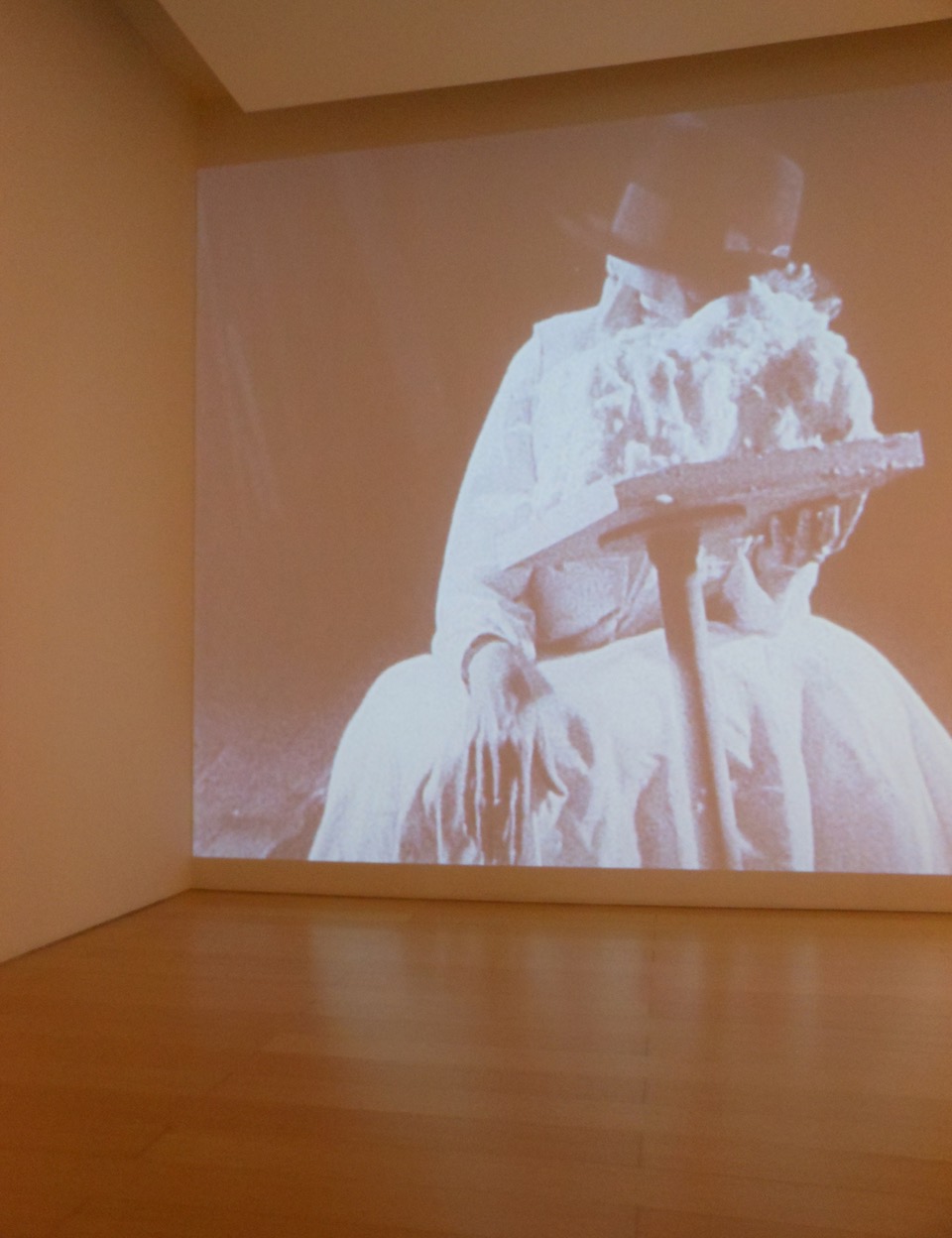
1. Sturtevant, Beuys Various Actions, 1971; photo: Teresa Lucia Cicciarella. Exhibition view from “Sturtevant Sturtevant”, Napoli, MADRE, 2015. Credits for Sturtevant’s work: Sturtevant Estate, Thaddaeus Ropac Gallery.
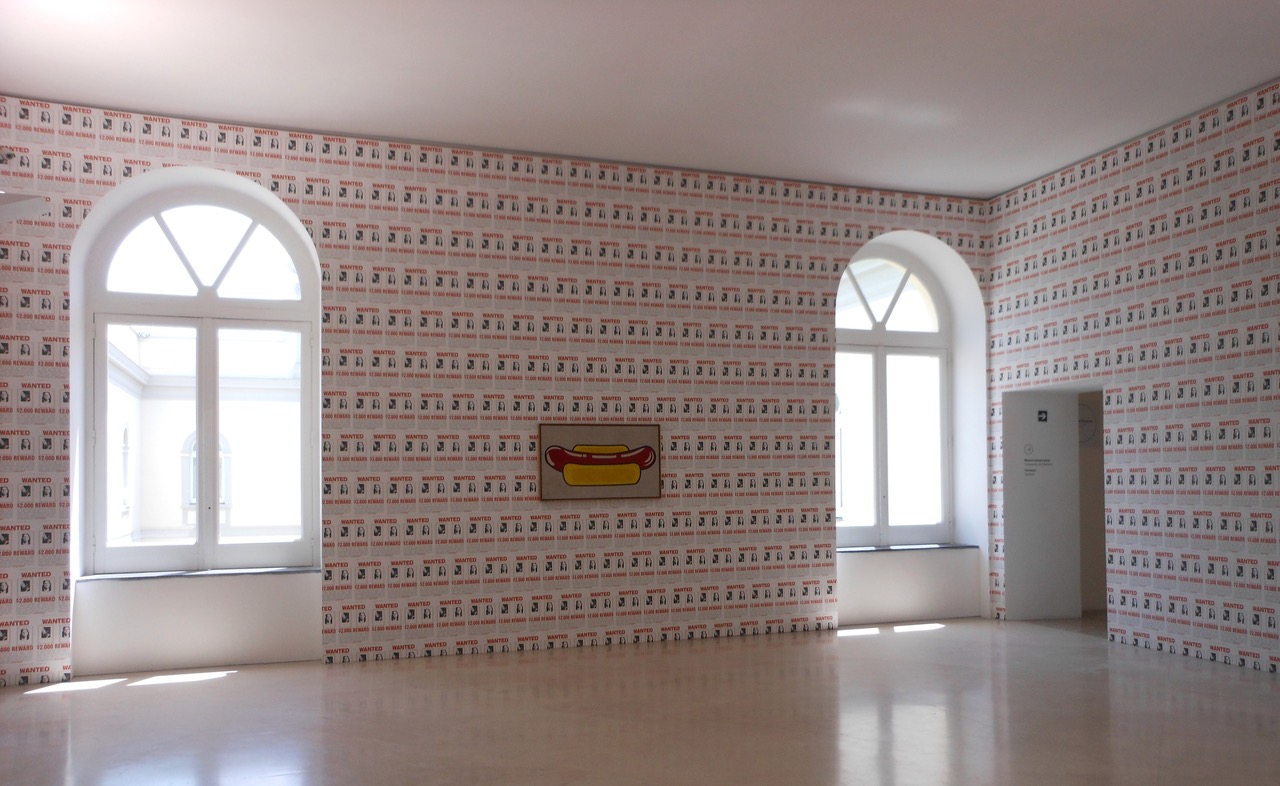
2. Sturtevant, Wanted (wallpaper), 1992; photo: Teresa Lucia Cicciarella. Exhibition view from “Sturtevant Sturtevant”, Napoli, MADRE, 2015. Credits for Sturtevant’s work: Sturtevant Estate, Thaddaeus Ropac Gallery.
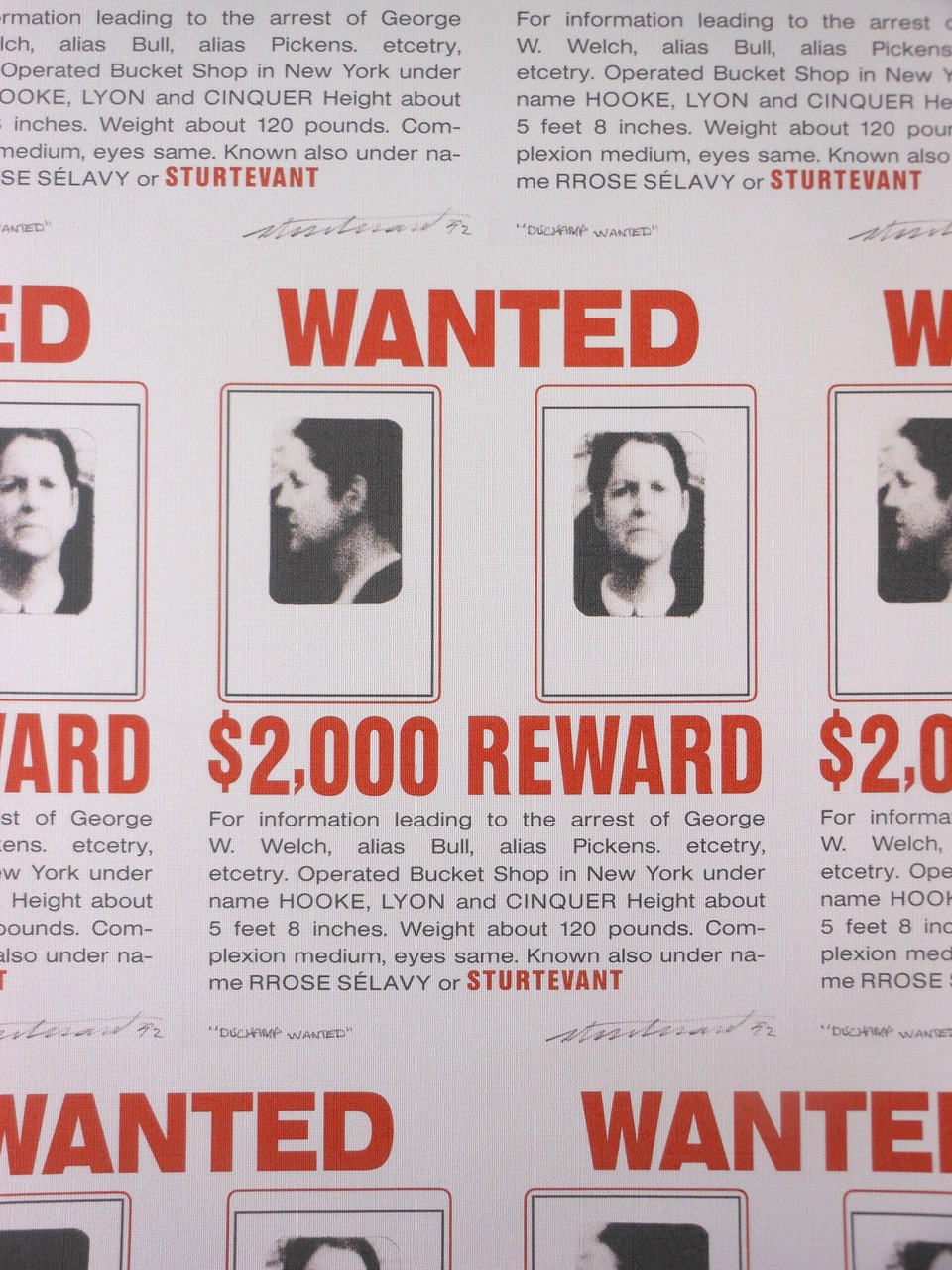
3. Sturtevant, Wanted (wallpaper), 1992; photo: Teresa Lucia Cicciarella. Detail from the exhibition “Sturtevant Sturtevant”, Napoli, MADRE, 2015. Credits for Sturtevant’s work: Sturtevant Estate, Thaddaeus Ropac Gallery.
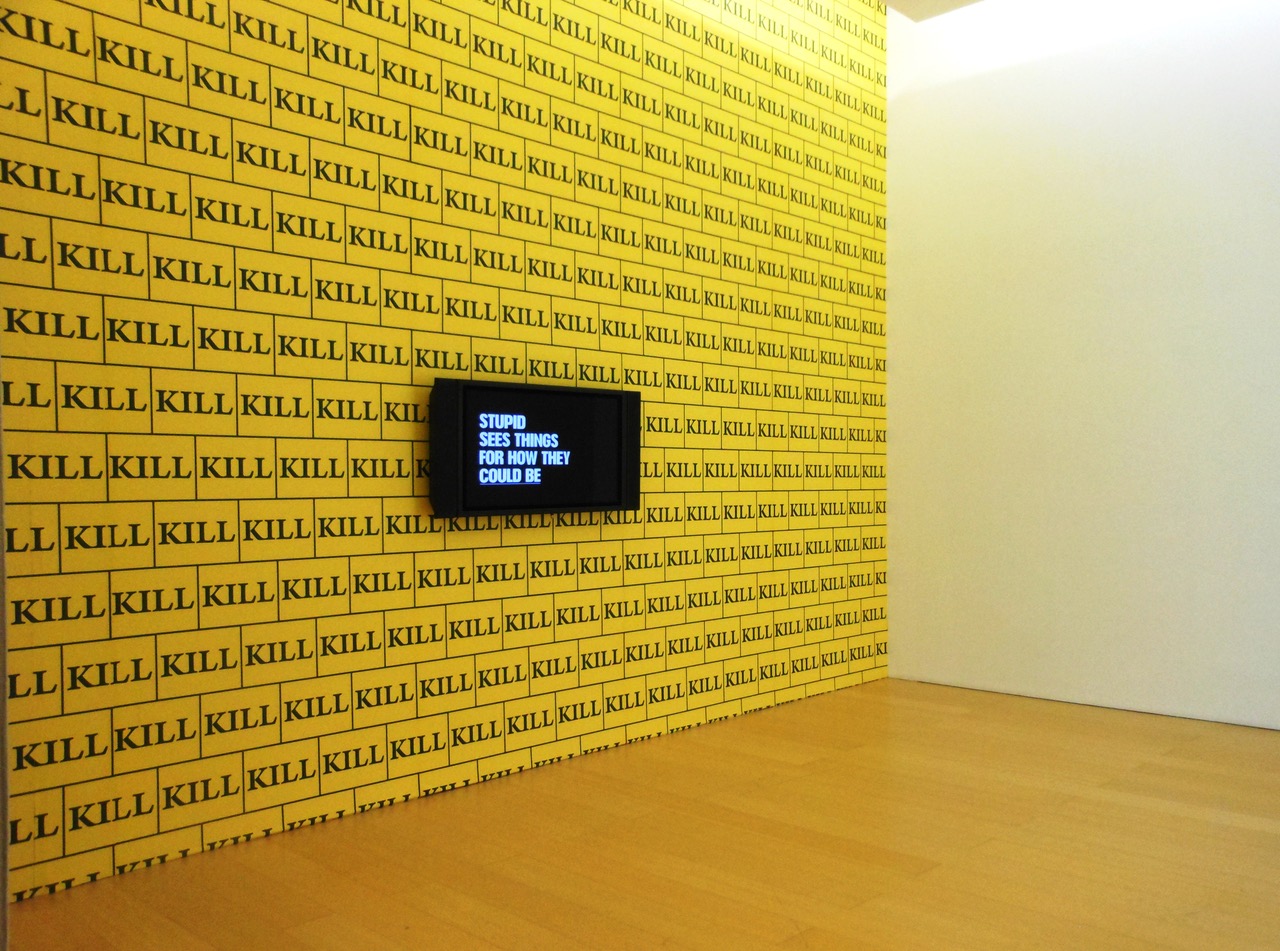
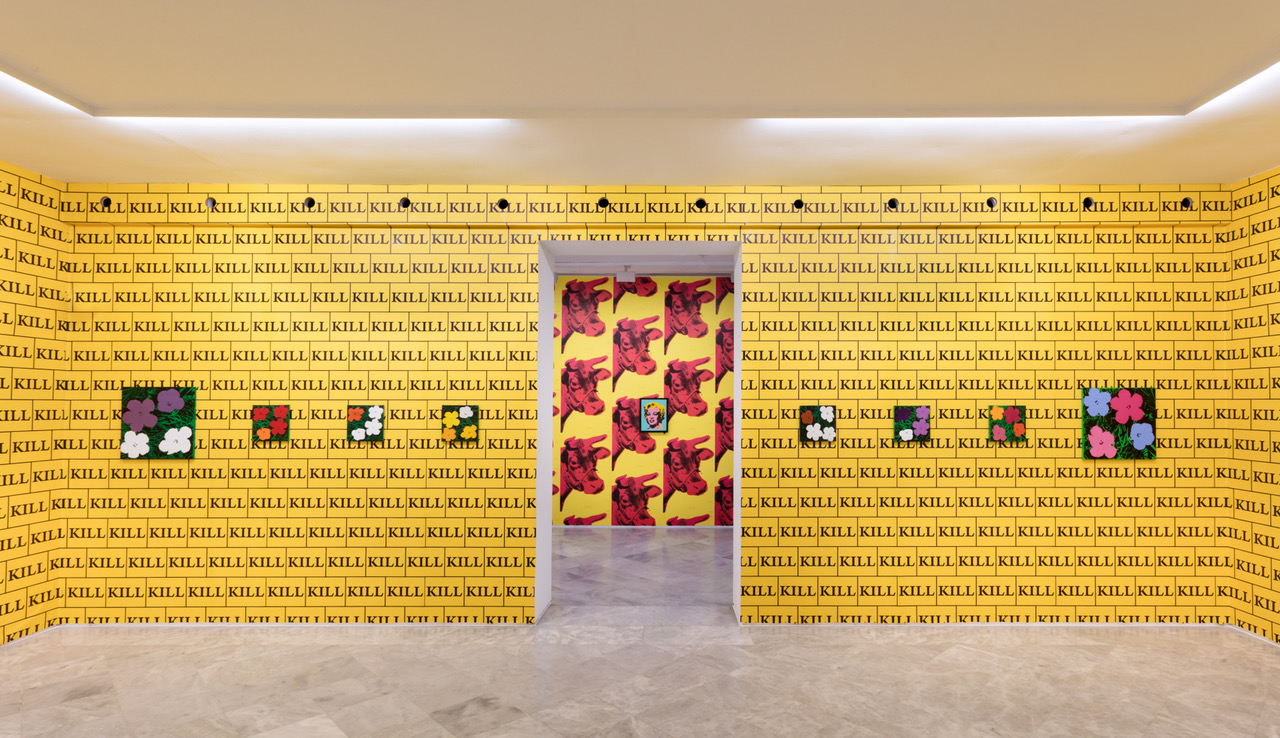
4. Sturtevant, Kill (wallpaper), 2003 e Stupidity, 2013; photo: Teresa Lucia Cicciarella. Exhibition view from “Sturtevant Sturtevant”, Napoli, MADRE, 2015. Credits for Sturtevant’s work: Sturtevant Estate, Thaddaeus Ropac Gallery.
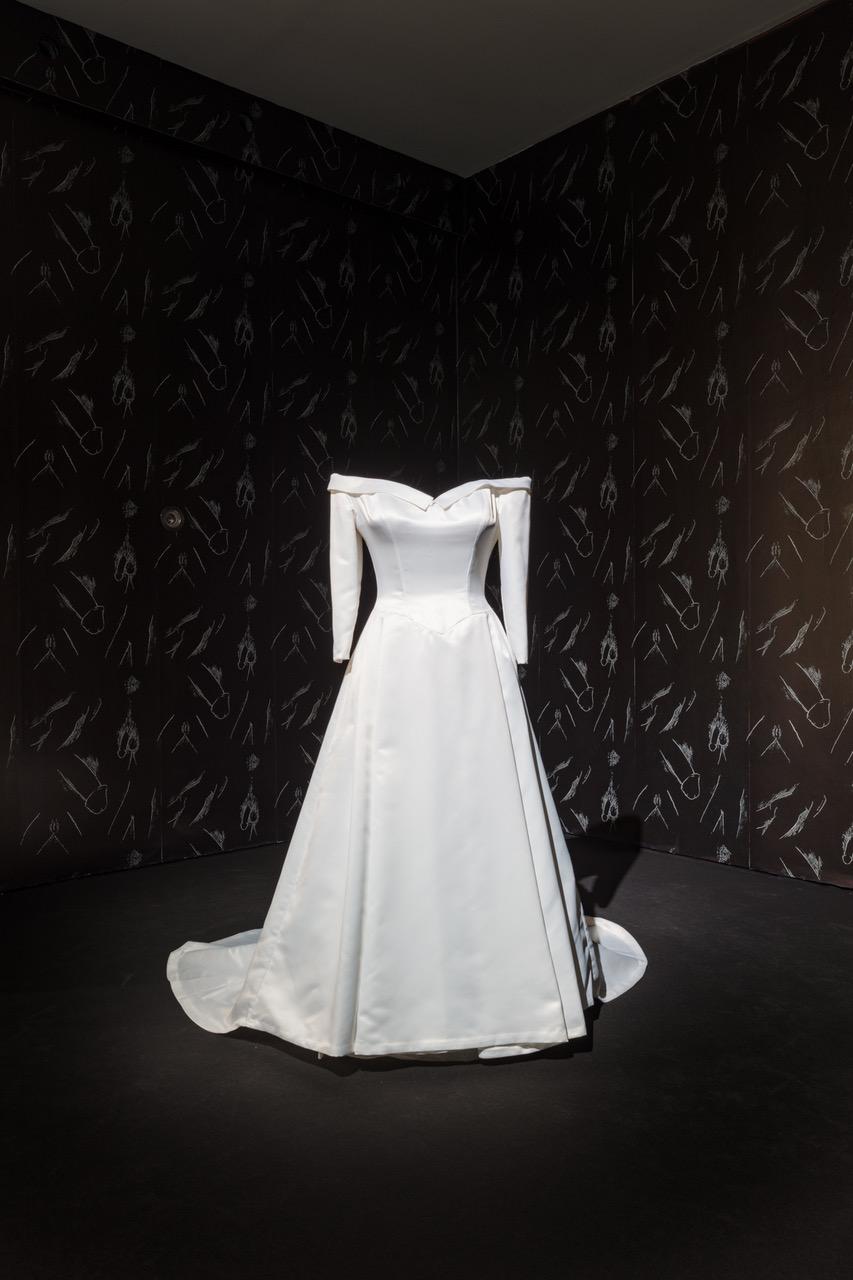
5. Installation view: “Sturtevant: the Echo of Innovation”, Seville, Centro Andaluz de Arte Contemporáneo (CAAC), 2025. Courtesy CAAC. Photo: Pepe Morón.
6. Installation view: “Sturtevant: the Echo of Innovation”, Seville, Centro Andaluz de Arte Contemporáneo (CAAC), 2025. Courtesy CAAC. Photo: Pepe Morón.
Sturtevant’s Wallpapers: An Ironic Perspective through Repetition and Critique
by Teresa Lucia Cicciarella, Ph.D.
The loss of the “aura” described by Walter Benjamin [1] and, more fundamentally, the possibilities opened up by “technical reproducibility” not only enabled a rapprochement between art and consumer goods, between the visual arts and new media, but also emancipated the artwork by bringing it to a more prosaic level of dissemination and reception. Citing the example of film, Benjamin observed that “the technical reproducibility of the product” was not, as in the case of literary works or paintings, “an external condition of their dissemination,” but rather a constitutive and fundamental condition. Building on Benjamin’s insight, this reflection may be extended to certain new media of contemporary art and their languages—foremost among them wallpaper—which, even when presented as an autonomous artwork, ipso facto coexists with factors of seriality and replicability. In 1936, within the “new era” analysed by Benjamin, the distinction between the concepts of original and copy was becoming obsolete. In the wake of the historical avant-gardes, this obsolescence opened up an almost infinite horizon of possibilities, marked above all by the expansion of artistic media and by the Duchampian proposal of the ready-made, which interrogated the very status of the artwork and its author.
These concepts are connected—albeit with irony and polemical verve—to the theory and practice of Elaine Sturtevant (née Elaine Frances Horan, Lakewood, USA, 1924 – Paris, 2014), an artist who, beginning with the mystification of her own birth date and name, asserted the will to construct a strong and independent identity.
Over the course of a long career, Sturtevant produced at least six different wallpapers. In the earlier instances (1990s), she reworked pre-existing artworks by other artists; from the 2000s onward, she reflected instead on the value of words and images belonging to the mass-media sphere. This body of work is rooted in the trajectory she began in the 1960s, the decade of her debut: wallpaper is, in fact, a significant medium within a corpus of works primarily concerned with mechanisms of repetition and, in parallel, with the analysis of “total units” or “total structures,” which often expanded into the environmental dimension of exhibition space.
Sturtevant may be considered a precursor of the appropriationism of the 1980s: her work, however, developed in singular temporal coincidence with the artists from whom she borrowed and re-presented visual vocabularies. Rather than quoting or paying homage, she conducted an inquiry into the “power of thought” [2], demonstrating a distinctly analytical intent aimed at posing direct questions about the artwork itself.
Sturtevant began by repeating, “as exactly as possible” [3], the works of her contemporaries, after meticulously studying their techniques. The choice of artists was determined exclusively by the recognisability of their work, which she would subtly undermine through minor differences. Through engagement with her critical positions, one encounters a central issue in the debates of the 1960s and 1970s: the question of authorship and the exercise of its functions, beginning with the reflections of Michel Foucault [4].
Sturtevant repeated others’ works as if they were a kind of ready-made, in a process not characterized by Duchampian aesthetic indifference but, on the contrary, by intervention upon an already formed and recognizable aesthetic object.
She debuted in New York in 1965 presenting replicas of Pop artists, foremost among them Andy Warhol’s Flowers, reproduced in over fifty examples using Warhol’s own silkscreen matrices, lent to her with a certain—perhaps amused—indifference.
The paradoxical tension between the substance and the appearance of the work increasingly undermined Sturtevant’s reception through the early 1970s, leading to misunderstanding or neglect by critics and the public. From 1974 to approximately 1985, the artist, emulating Marcel Duchamp, withdrew into private life.
Her return to art—followed by her permanent move to Paris in 1990—saw Sturtevant conceive her first wallpaper inspired by Duchamp, and subsequently produce further works in this medium. Her interest in wallpaper may be attributed to two converging factors: on the one hand, the increasing use of the medium by famous artists such as Robert Gober; on the other, the observation of the dynamics of the World Wide Web.
In 1992, Sturtevant created a series of works engaging with the legacy of Duchamp, whose persona she had already adopted on several occasions since 1966. In 1969, she played with her “outlaw” status—metaphorically resulting from her appropriations—by altering Duchamp’s photo-collage Wanted through the insertion of her own name and bodily parameters. Based on this small collage, she created, in 1992, the pattern for her first wallpaper, built on the iteration of the image combined with the repeated inscription “Wanted,” pushed to an auto-ironic paroxysm.
A few years later, she reworked Male and Female Genital Wallpaper (1989) by Gober, exhibiting it in Düsseldorf in 1995. Long interested in themes related to sexuality, Sturtevant installed her reprint of the pattern—centred on the repetition of male and female genitalia—within an environmental installation that also included a wedding dress, likewise appropriated from Gober.
Her work on image reiteration continued in 1996 with the repetition of Warhol’s celebrated Cow wallpaper (1966), first pioneering affirmation of wallpaper as a medium of contemporary art. Sturtevant produced Warhol Cow, maintaining the same dimensions and chromatic pairing as Warhol’s original.
A particularly stimulating comparison between original and repeated works occurred during Sturtevant’s retrospective at the Museum of Modern Art in New York (“Sturtevant: Double Trouble”, 2014-15), which coincided with a retrospective of Gober, where the original wallpaper was also displayed. The two works were thus indistinguishable on a purely visual level. A further paradox arose from the coexistence, again at MoMA, of Sturtevant’s Warhol Cow Paper and Warhol’s Cow (1966), installed in the museum’s 54th Street entrance hall.
A different example is a black-and-white photographic wallpaper produced in 1998, combining a detail of the Empire State Building (a frame from Warhol Empire – Sturtevant, 1972) and a female nude.
With the advent of the new millennium, Sturtevant’s work increasingly focused on the mechanisms of iteration triggered by the web. Themes such as the digital archive and the vast reservoir of images accessible via search engines gained prominence, prompting viewers to reflect on the pervasive (and alienating) nature of contemporary modes of image production and consumption.
From such reflections emerged, in 2003, during the months of the U.S. invasion of Iraq, the wallpaper Kill, a chromatic and literal reference to Kill Bill: Volume I (2003) by Quentin Tarantino.
Another instance of Sturtevant’s practice of appropriating imagery from online archives is Serpentine Owl Wallpaper (2013), centred on the repetition of a video still: a close-up of an owl. Obscuring the entire image is the inscription “iStock video,” explicitly indicating its royalty-free origin.
The subject was chosen according to a Duchampian criterion of “aesthetic indifference”, intended to expose the nature of the vast online visual reservoir, to which no definitive or discriminating aesthetic criterion can be applied.
Sturtevant’s modus operandi is confirmed by her own statement: “[…] the dynamics of repetition […] has nothing to do with copy. Repetition is displacement; repetition is difference; repetition is pushing the limits of resemblance and limitation […] For instance, Andy Warhol repeated, but he did not do repetition. And his brilliance really lies in the fact that repeat is surface. You’re just talking about the surface” [5]. It is precisely around the notion of “surface” that the circle closes on Sturtevant’s reflections on wallpaper, developed in full coherence with the theory and practice of previous decades.
NOTES
[1] W. Benjamin, The Work of Art in the Age of its Technological Reproducibility, 1936.
[2] Sturtevant, from the interview with Ivan Ogilvie on“Nowness.com”, 2013; https://www.nowness.com/story/sturtevant-leaps-jumps-andbumps
[3] Sturtevant in D. Cameron, A Conversation: A Salon History of Appropriation with Leo Castelli and Elaine Sturtevant in “Flash Art”, n. 143, 1988.
[4] M. Foucault, Qu’est-ce qu’un auteur?, 1969.
[5] Sturtevant in conversation with Bruce Hainley and Michael Lobel. New York, july 25-26, 2007.
AUTHOR’S BIOGRAPHY
Teresa Lucia Cicciarella, Ph.D. (Marsala, 1981) is an Italian art historian and lecturer, currently serving as Adjunct Lecturer of Contemporary Art History and Design at the University of Tuscia (Viterbo). After obtaining her degree in Contemporary Art History (DAMS Arte, University of Palermo), she pursued postgraduate specialization in Contemporary Art History (2011) at the University of Siena, where she first engaged with the study of wallpaper as a medium within contemporary art.
She holds a Ph.D. in Memory and Materiality of Works of Art through the Processes of Production, Historicization, Conservation, and Musealization (University of Tuscia, 2015), with a dissertation entitled From Background to Foreground: Wallpapers as Works of Art from the 1960s to the Present. She also teaches at an art high school and has collaborated with public and private institutions on educational initiatives and museum mediation projects, while concurrently working as a freelance art critic. Her research interests include twentieth- and twenty-first-century Art history, Design history, Art history education, Applied Arts, and the interconnections between Art and Fashion.
Consult our other wallpaper artists
BALDESSARI John • BOWIE David • BOYCE Sonia • CORDIER Frédéric • GENERAL IDEA • GOUGEON Diane • HADID Zaha • MONKMAN Kent • MONNET Caroline • MORELLI François • MYRE Nadia • PAREDES Cecilia • PÉTRIN Dominique • STURTEVANT Elaine • WARHOL Andy
CURATOR
CLAUDE GOSSELIN, C.M.
Directeur général et artistique
General and Artistic Director
claude.gosselin@ciac.ca